-
Enhancing Legal Services with ChatGPT for Legal Businesses
In today’s fast-paced digital world, staying ahead of the curve is imperative for legal businesses. Leveraging cutting-edge technologies can provide a significant competitive advantage. One such technology that is transforming the legal landscape is ChatGPT for legal businesses.
ChatGPT for Legal Businesses: An Overview
ChatGPT, powered by OpenAI’s advanced language model, GPT-3.5, is a versatile AI tool that can be integrated into various applications to streamline processes, improve efficiency, and enhance client interactions. Legal firms are discovering the immense potential of ChatGPT to optimize their operations and provide better services.

1. Enhanced Client Engagement
One of the key advantages of incorporating ChatGPT into legal businesses is improved client engagement. By utilizing ChatGPT, firms can offer instant responses to client inquiries on their websites, providing a round-the-clock virtual assistant. This feature not only enhances customer satisfaction but also ensures that potential clients receive immediate attention, increasing the likelihood of conversion.
2. Automating Routine Tasks
Legal professionals often find themselves bogged down by administrative tasks, such as document review, contract drafting, and legal research. ChatGPT can be harnessed to automate these routine tasks, freeing up valuable time for lawyers to focus on more complex, strategic matters. This not only boosts productivity but also reduces the risk of human errors.
3. Legal Research Made Effortless
ChatGPT’s extensive knowledge base enables it to conduct thorough legal research within seconds. This can be a game-changer for legal businesses, as it accelerates the process of gathering relevant case law, statutes, and precedents. Lawyers can then use this information to build stronger cases and provide more informed advice to clients.
4. Drafting Legal Documents
Crafting legal documents can be a time-consuming and meticulous process. ChatGPT for legal businesses can assist in generating drafts for various legal documents, from contracts to wills. Lawyers can then review and refine these drafts, significantly reducing turnaround times and minimizing the chance of errors.
5. Data Security and Compliance
Privacy and data security are paramount in the legal industry. ChatGPT can be customized to meet specific data security and compliance requirements. This ensures that confidential client information remains protected, and the firm complies with industry regulations and standards.
In conclusion, ChatGPT for legal businesses is a powerful tool that can revolutionize the way law firms operate. It enhances client engagement, automates routine tasks, streamlines legal research, expedites document drafting, and maintains the highest standards of data security and compliance. By embracing this AI technology, legal businesses can gain a competitive edge, provide more efficient services, and position themselves as leaders in the industry.
Incorporating ChatGPT into your legal practice is a forward-thinking step that can yield substantial benefits. As the legal landscape continues to evolve, staying at the forefront of technology with ChatGPT is a strategic move that will ensure your firm’s long-term success.
-
Harnessing the Potential of a Custom ChatGPT App for Enterprise Success
In today’s hyper-competitive business environment, enterprises are constantly searching for innovative solutions to stay ahead of the curve. One such solution that has gained prominence is the development of a custom ChatGPT app. In this article, we’ll explore the key steps involved in creating a personalized chatbot application to cater enterprise needs.

The Need for a Custom ChatGPT App in Enterprises
Enterprises are increasingly recognizing the limitations of generic chatbots. These off-the-shelf solutions often fall short when it comes to delivering a truly personalized and adaptable conversational experience. This is where a custom ChatGPT app shines. It offers the flexibility and control required to meet the unique demands of businesses, providing an unmatched level of customization and integration.
Step 1: Clearly Define Your Objectives
Every successful project begins with a clear vision. Define the objectives of your custom ChatGPT app. Are you aiming to enhance customer support, boost sales, or provide a unique user experience? Establishing these goals will guide the entire development process and ensure your app aligns with your enterprise’s specific needs.
Step 2: Gather and Prepare Data
Building a custom ChatGPT app necessitates data. Collect and preprocess relevant information, such as historical customer interactions, product details, FAQs, and any other data that will aid in training your AI model. You can either use existing datasets or create your own by fine-tuning pre-trained models with proprietary data.
Step 3: Model Selection and Fine-Tuning
Select the AI model that best suits your enterprise’s requirements. GPT-3.5, the technology behind ChatGPT, offers exceptional natural language understanding capabilities. Fine-tune the model using your enterprise data to ensure it comprehends context and delivers accurate responses tailored to your objectives.
Step 4: Development and Integration
Now it’s time to bring your custom ChatGPT app to life. Develop the application using programming languages such as Python and seamlessly integrate it with your existing systems and platforms. This ensures that the chatbot can communicate effectively with your enterprise infrastructure.
Step 5: User Interface Design
A well-crafted user interface (UI) is pivotal to user satisfaction. Design an intuitive and visually appealing interface for your ChatGPT app that mirrors your brand’s identity. Implement user-friendly features like easy navigation, chat history, and personalized interactions to enhance the user experience.
Step 6: Testing and Continuous Improvement
Thoroughly test your custom ChatGPT app to identify and address any glitches or inconsistencies. Solicit feedback from users and continuously refine the model to enhance performance and accuracy. Regular updates are vital to keep the chatbot effective and aligned with your evolving enterprise needs.
Step 7: Deployment and Ongoing Maintenance
Once your custom ChatGPT app meets your standards, deploy it for use by customers or employees. Monitor its performance, gather analytics, and provide continuous maintenance to ensure it remains an asset that adds value to your organization.
Conclusion
A custom ChatGPT app tailored to the unique requirements of your enterprise can revolutionize customer interactions and drive business growth. By following these seven steps, you can create a powerful AI-driven chatbot that elevates user experiences and positions your organization for success in the competitive landscape. Embrace the potential of a custom ChatGPT app, and unlock new avenues for engagement and efficiency.
-
Embeddings as a Service: Unlocking the Power of Contextual Representations
In the realm of natural language processing and machine learning, embeddings have revolutionized the way we understand and process textual data. Embeddings, also known as word vectors or contextual representations, capture the semantic meaning and contextual relationships between words or phrases. The emergence of embeddings as a service has further accelerated the accessibility and utilization of these powerful language models. In this article, we will explore the significance of embeddings as a service, their applications, and how they unlock the power of contextual representations for various AI-driven tasks.

Understanding Embeddings:
Embeddings are numerical representations of words or phrases in a vector space, where words with similar meanings or contextual usage are closer to each other. They capture the semantic relationships and contextual information of words, enabling AI models to understand and process natural language more effectively. Embeddings are typically generated using deep learning techniques, such as word2vec, GloVe, or transformer-based models like BERT and GPT.
The Power of Embeddings as a Service:
Embeddings as a service provides developers and organizations with pre-trained embedding models that can be readily integrated into their applications or AI workflows. These services eliminate the need for training embeddings from scratch, saving time and computational resources. By leveraging embeddings as a service, developers can access powerful contextual representations and enhance the capabilities of their AI-driven solutions.
Applications of Embeddings as a Service:
- Natural Language Understanding: Embeddings as a service enables natural language understanding by capturing the semantic meaning and contextual relationships between words. It facilitates tasks such as named entity recognition, sentiment analysis, text classification, and question-answering systems. By utilizing pre-trained embeddings, developers can quickly build accurate and efficient language models without the need for extensive training data or computational resources.
- Recommender Systems: Embeddings play a crucial role in building recommender systems. They help model user preferences and item similarities, allowing for personalized recommendations. By leveraging embeddings as a service, developers can enhance the performance of recommender systems, leading to improved user experiences and increased customer engagement.
- Text Generation and Summarization: Embeddings as a service empowers text generation and summarization tasks. By understanding the contextual relationships between words, developers can generate coherent and contextually relevant text. Applications include chatbots, automated content generation, and document summarization, where the generated text maintains the semantic meaning and coherence of the original content.
Benefits of Embeddings as a Service:
- Time and Resource Efficiency: Embeddings as a service eliminates the need for training embeddings from scratch, saving valuable time and computational resources. Developers can quickly integrate pre-trained embeddings into their applications, reducing the development cycle and accelerating time-to-market.
- Access to State-of-the-Art Models: Embeddings as a service provides access to state-of-the-art models trained on vast amounts of textual data. Developers can leverage these models without the need for large-scale training datasets or extensive computational infrastructure.
- Enhanced Performance: Pre-trained embeddings capture rich contextual representations, resulting in improved performance across various natural language processing tasks. By leveraging embeddings as a service, developers can benefit from the enhanced capabilities of these powerful language models and achieve more accurate and effective AI-driven solutions.
- Scalability and Flexibility: Embeddings as a service offers scalability, allowing developers to handle large volumes of data and diverse use cases. These services are flexible, accommodating different application scenarios and supporting multiple programming languages and frameworks.
In conclusion, embeddings as a service has democratized access to powerful contextual representations, enabling developers and organizations to leverage the benefits of embeddings without the need for extensive training or computational resources. By utilizing pre-trained embeddings, developers can enhance the performance of natural language processing tasks, recommender systems, text generation, and summarization. The accessibility and convenience of embeddings as a service unlock the power of contextual representations, driving innovation and empowering AI-driven applications across industries. As the field of natural language processing continues to advance, leveraging embeddings as a service becomes increasingly valuable for organizations seeking to harness the full potential of textual data and unlock new opportunities in the world of AI and machine learning.
Articles referenced include:
https://www.leewayhertz.com/embeddings-as-a-service/
https://www.leewayhertz.com/what-is-embedding/ -
Data Annotation Services: Unlocking the Power of Labeled Data
In the realm of artificial intelligence (AI) and machine learning, data annotation services have emerged as a critical component in training and developing intelligent systems. These services involve the process of labeling and annotating data, providing valuable insights and context that fuel the accuracy and effectiveness of AI algorithms. In this article, we will explore the significance of data annotation services, their applications, and how they contribute to driving innovation and unlocking the power of labeled data.

The Importance of Data Annotation Services:
Data annotation services play a crucial role in AI and machine learning projects by providing labeled data that serves as the foundation for training and validating models. These services involve human annotators or specialized tools that meticulously label various elements within datasets, such as images, text, audio, or video, with relevant tags, categories, or attributes. The labeled data acts as a reference for machine learning algorithms to learn patterns, make predictions, and perform complex tasks.
Applications of Data Annotation Services:
- Computer Vision: In computer vision applications, data annotation services are used to label and annotate images or videos. Annotators identify and label objects, shapes, facial features, or other visual elements, enabling algorithms to recognize and classify these elements accurately. This facilitates applications such as object detection, image segmentation, facial recognition, and autonomous driving.
- Natural Language Processing (NLP): Data annotation services are vital for NLP tasks, including sentiment analysis, chatbots, machine translation, and named entity recognition. Annotators mark and label text data, such as sentences, paragraphs, or words, with attributes such as sentiment, part-of-speech tags, or semantic roles, enabling algorithms to understand and process human language effectively.
- Speech and Audio Processing: In speech and audio processing, data annotation services help transcribe audio recordings, annotate speech segments, and label acoustic attributes. This labeled data enhances applications like speech recognition, speaker identification, voice assistants, and audio classification.
Benefits of Data Annotation Services:
- Improved Model Accuracy: Labeled data from data annotation services provides ground truth information that enables machine learning models to learn and make accurate predictions. The quality and precision of annotations directly impact the performance and reliability of AI algorithms, leading to improved model accuracy and effectiveness.
- Time and Cost Efficiency: Outsourcing data annotation services to specialized providers can save significant time and resources. These providers have the expertise, infrastructure, and tools to annotate large volumes of data efficiently, allowing organizations to focus on core tasks and accelerate their AI projects.
- Scalability and Flexibility: Data annotation services offer scalability, allowing organizations to annotate datasets of varying sizes. Providers can handle large-scale annotation projects, accommodating expanding datasets and evolving requirements. Moreover, annotation services are flexible, accommodating different data types and annotation methodologies based on specific project needs.
- Quality Control and Consistency: Data annotation services often include quality control measures to ensure accurate and consistent annotations. Annotators follow predefined guidelines, perform regular reviews, and undergo training to maintain consistency and enhance the reliability of the labeled data.
In conclusion, data annotation services have become a critical component in AI and machine learning projects, enabling organizations to leverage the power of labeled data. By providing accurate and context-rich annotations, these services enhance model accuracy, improve performance, and enable AI algorithms to tackle complex tasks effectively. Whether applied in computer vision, natural language processing, or audio processing, data annotation services offer time and cost efficiency, scalability, and quality control. As AI continues to advance, harnessing the potential of data annotation services becomes increasingly crucial for organizations seeking to innovate, make data-driven decisions, and stay ahead in the evolving landscape of artificial intelligence.
Articles referenced include:
https://www.leewayhertz.com/data-annotation-services/
https://www.leewayhertz.com/llms-in-synthesizing-training-data/ -
Unlocking Data-Driven Success: How to Hire Data Scientists and Data Scientist Developers
In the age of data-driven decision-making, organizations are increasingly recognizing the importance of hiring skilled data scientists and data scientist developers. These professionals possess the expertise to analyze vast amounts of data, extract valuable insights, and drive innovation within organizations. In this article, we will explore the significance of hiring data scientists and data scientist developers and discuss essential considerations to make when building a high-performing data science team.

Why Hire Data Scientists and Data Scientist Developers?
- Data Analysis Expertise: Data scientists are skilled in extracting actionable insights from complex datasets. They possess the knowledge of statistical analysis, machine learning, and data visualization techniques, allowing them to uncover patterns, trends, and correlations in data that can inform strategic decision-making.
- Innovation and Problem Solving: Data scientists and data scientist developers are highly skilled problem solvers. They excel in developing innovative solutions to complex business challenges by leveraging data-driven approaches and advanced analytics techniques.
- Predictive Analytics and Forecasting: These professionals have the ability to build predictive models and forecasting algorithms that enable organizations to anticipate future trends, optimize resource allocation, and make informed decisions based on data-driven predictions.
- Effective Data Communication: Data scientists are proficient in translating complex data insights into actionable recommendations and insights that can be understood by stakeholders across various departments. Their expertise in data visualization and storytelling ensures effective communication of data findings.
Essential Considerations for Hiring Data Scientists and Data Scientist Developers:
- Clearly Define Job Roles and Requirements: Clearly define the roles and responsibilities of the data scientist and data scientist developer positions based on your organization’s specific needs. Determine the skill sets, qualifications, and experience required for each role.
- Technical Proficiency: Look for candidates with a strong foundation in mathematics, statistics, programming languages (such as Python or R), and machine learning algorithms. Assess their proficiency in data manipulation, data visualization, and knowledge of relevant data analysis tools and frameworks.
- Domain Expertise: Consider hiring data scientists or data scientist developers who have domain expertise in your industry. They will possess a deeper understanding of the specific challenges and opportunities related to your business, which can greatly enhance the impact of their data-driven insights.
- Problem-Solving Abilities: Evaluate candidates’ problem-solving skills through technical assessments and case studies. Look for individuals who can approach complex problems with creativity, critical thinking, and a structured problem-solving methodology.
- Collaborative and Communication Skills: Data scientists and data scientist developers need to collaborate effectively with cross-functional teams and communicate complex concepts to stakeholders. Assess candidates’ ability to work in a team, their communication skills, and their aptitude for translating technical insights into actionable recommendations.
- Continuous Learning and Adaptability: Data science is a rapidly evolving field, and successful data scientists and data scientist developers demonstrate a passion for continuous learning. Look for candidates who are enthusiastic about staying up-to-date with the latest trends, techniques, and advancements in data science.
In conclusion, hiring skilled data scientists and data scientist developers is crucial for organizations aiming to harness the power of data-driven decision-making. These professionals bring a unique set of skills, including data analysis expertise, innovation, predictive analytics, and effective data communication. When hiring data scientists and data scientist developers, clearly define job roles and requirements, assess technical proficiency, consider domain expertise, evaluate problem-solving abilities, and prioritize collaborative and communication skills. By building a high-performing data science team, organizations can unlock the full potential of their data, drive innovation, and gain a competitive edge in today’s data-centric business landscape.
Articles referenced include:
https://www.leewayhertz.com/hire-data-scientists/
https://www.leewayhertz.com/what-is-exploratory-data-analysis/ -
Unleashing the Potential: The Rise of Adaptive AI Development Companies
In the ever-evolving world of artificial intelligence (AI), adaptive AI development companies are at the forefront of driving innovation and pushing the boundaries of what is possible. With the emergence of adaptive AI technology, these companies are shaping the future by creating intelligent systems that can learn, evolve, and adapt to changing circumstances. In this article, we will explore the significance of adaptive AI and discuss how adaptive AI development companies are revolutionizing the AI landscape, empowering organizations with cutting-edge solutions.
Understanding Adaptive AI:
Adaptive AI refers to the capability of AI systems to learn from data, improve performance, and adapt to new situations autonomously. Unlike traditional AI models that are static and require constant manual updates, adaptive AI utilizes advanced algorithms and techniques such as machine learning, deep learning, and reinforcement learning to continuously learn and evolve. This technology enables AI systems to understand complex patterns, make accurate predictions, and dynamically adjust their behavior in response to changing environments.
The Role of Adaptive AI Development Companies:
Adaptive AI development companies are at the forefront of harnessing the power of adaptive AI technology. Their expertise lies in creating intelligent systems that can adapt and optimize their performance over time. These companies combine domain knowledge, data analysis, and advanced AI techniques to build adaptive AI solutions tailored to meet specific business needs. They work closely with organizations to understand their challenges, design customized AI models, and empower them with intelligent tools that can learn and adapt alongside their evolving requirements.
Key Aspects of Adaptive AI Development Companies:
- Data-Driven Approach: Adaptive AI development companies leverage vast amounts of data to train AI models and enable adaptive capabilities. They employ advanced data analytics techniques to extract valuable insights, identify patterns, and build adaptive algorithms that can continuously learn from new information.
- Continuous Learning and Evolution: Adaptive AI development companies create AI systems that can learn from experience and improve their performance over time. By incorporating machine learning and deep learning algorithms, these companies enable AI models to autonomously adapt to changing data and evolving user needs, resulting in increasingly accurate and efficient outcomes.
- Real-Time Adaptability: Adaptive AI development companies focus on building AI solutions that can dynamically adjust their behavior in real-time. These solutions can adapt to shifting circumstances, handle unforeseen scenarios, and make informed decisions based on up-to-date information, ensuring optimal performance in dynamic environments.
- Personalized and Context-Aware Solutions: Adaptive AI development companies understand the importance of personalization and context-awareness. They design AI models that can adapt to individual user preferences and specific contextual factors, tailoring their responses and recommendations to provide a personalized and enhanced user experience.
Benefits of Adaptive AI Development Companies:
- Improved Accuracy and Performance: By continuously learning and adapting, adaptive AI solutions developed by these companies exhibit higher accuracy and performance compared to static models. This enables organizations to make better decisions, optimize processes, and achieve superior outcomes.
- Enhanced Efficiency and Automation: Adaptive AI development companies empower organizations with AI solutions that automate tasks, streamline processes, and optimize resource allocation. Through adaptive capabilities, these solutions can autonomously identify bottlenecks, fine-tune processes, and deliver greater efficiency and productivity.
- Future-Proof Solutions: Adaptive AI development companies create AI models that can evolve and adapt alongside changing business needs and technological advancements. This future-proofs organizations by ensuring their AI systems remain relevant and effective even in rapidly changing environments.
- Agile Decision-Making: Adaptive AI solutions enable organizations to make agile and data-driven decisions. By leveraging real-time adaptability, these solutions provide organizations with actionable insights, predictions, and recommendations that can drive proactive decision-making and foster innovation.
In conclusion, adaptive AI development companies are revolutionizing the AI landscape by creating intelligent systems that can learn, evolve, and adapt. Through advanced algorithms, continuous learning, and real-time adaptability, these companies enable organizations to harness the power of adaptive AI technology. The benefits of adaptive AI, including improved accuracy, enhanced efficiency, future-proof solutions, and agile decision-making, position organizations at the forefront of innovation and provide them with a competitive edge. As adaptive AI continues to advance, adaptive AI development companies will play a pivotal role in unlocking the full potential of AI technology, driving transformation across industries, and shaping a more intelligent future.
Articles referenced include:
https://www.leewayhertz.com/adaptive-ai-development-company/
https://www.leewayhertz.com/how-to-implement-adaptive-ai/ -
The Role of Stable Diffusion Developers in AI Software Development Companies
In the rapidly advancing field of AI software development, stable diffusion developers play a vital role in ensuring the successful integration and adoption of artificial intelligence solutions. These skilled professionals possess the expertise and knowledge required to navigate the complexities of AI implementation and facilitate seamless diffusion within organizations. In this article, we will explore the significance of stable diffusion developers within AI software development companies and discuss how their specialized skills contribute to driving innovation and maximizing the value of AI technology.
Understanding Stable Diffusion:
Stable diffusion refers to the controlled and effective spread of AI technology within an organization. It involves the integration of AI solutions into existing systems, processes, and workflows, while also addressing the cultural and human factors that influence technology adoption. The goal of stable diffusion is to create an environment where AI becomes an integral part of an organization’s operations, driving productivity, efficiency, and innovation.
The Role of Stable Diffusion Developers:
Stable diffusion developers are the professionals within AI software development companies who specialize in facilitating the seamless integration and adoption of AI solutions. They possess a unique set of skills and expertise that enables them to effectively bridge the gap between technology and the organizational context. Their role extends beyond traditional software development as they focus on the successful implementation and diffusion of AI technology within client organizations.
Key Responsibilities of Stable Diffusion Developers:
- Comprehensive Assessment: Stable diffusion developers begin by conducting a thorough assessment of the organization’s infrastructure, systems, and processes. They work closely with stakeholders to identify areas where AI can deliver the most significant impact and define clear objectives for implementation. This assessment helps them understand the specific challenges and opportunities present, allowing for tailored solutions.
- Customized Solution Development: Once the assessment is complete, stable diffusion developers leverage their AI software development skills to design and develop customized solutions. These solutions are tailored to meet the unique requirements of the organization, ensuring a seamless fit within existing infrastructure. They focus on building robust AI algorithms, intuitive user interfaces, and scalable systems that can adapt to future growth.
- Integration and Compatibility: Stable diffusion developers focus on integrating AI solutions into the organization’s existing systems, minimizing disruption and avoiding data silos. They possess the technical expertise to ensure compatibility and seamless interaction between AI software and other tools or databases. This integration enables organizations to leverage AI technology without significant changes to their established workflows.
- Change Management and User Training: Implementing AI solutions often requires a cultural shift within an organization. Stable diffusion developers understand the importance of change management and invest in strategies to facilitate a smooth transition. They collaborate with stakeholders to address any resistance to change, communicate the benefits of AI adoption, and provide user training programs that empower employees to embrace and utilize AI tools effectively.
- Ongoing Support and Evaluation: Stable diffusion developers provide continuous support to organizations after the implementation of AI solutions. They monitor system performance, address any technical issues promptly, and incorporate user feedback to refine and enhance the software’s functionality. Ongoing evaluation ensures the long-term stability and effectiveness of the AI solution.
The Benefits of Stable Diffusion Developers:
- Expertise and Specialization: Stable diffusion developers possess specialized skills and knowledge in AI software development, enabling them to navigate the complexities of implementation. Their expertise ensures that organizations make informed decisions, avoid common pitfalls, and maximize the value of AI technology.
- Seamless Integration: With their technical know-how, stable diffusion developers ensure the smooth integration of AI solutions into existing systems. This minimizes disruption to operations and allows organizations to seamlessly adopt and leverage AI technology.
- Change Adoption and User Empowerment: Stable diffusion developers play a crucial role in change management by addressing concerns and resistance to AI adoption. They provide user training programs that empower employees to embrace AI tools effectively, promoting a positive mindset towards technology integration.
- Innovation and Business Growth: By successfully implementing AI solutions, stable diffusion developers contribute to driving innovation and business growth. AI-powered automation, data analytics, and intelligent decision-making capabilities enhance operational efficiency, enable data-driven insights, and unlock new opportunities for organizations.
In conclusion, stable diffusion developers are instrumental in ensuring the successful integration and adoption of AI solutions within organizations. Their specialized skills, combined with their ability to navigate complex technical and human aspects, contribute to the seamless diffusion of AI technology. By conducting comprehensive assessments, developing customized solutions, facilitating change management, and providing ongoing support, stable diffusion developers enable organizations to harness the full potential of AI, driving productivity, efficiency, and innovation. Their role within AI software development companies is paramount in ensuring the successful implementation and long-term stability of AI technology within organizations.
Articles referenced include:
https://www.leewayhertz.com/stable-diffusion-developers/
https://www.leewayhertz.com/artificial-intelligence-application-development-company/ -
Top 10 Metaverse Development Firms 2023
Metaverse is the buzzword of this decade, and internet companies like as Google, Facebook (Meta), and Microsoft are investing in metaverse initiatives, which is increasing its significance. The metaverse is transforming into a vast decentralised virtual environment of the future as its popularity grows. Bloomberg estimates that by 2024, the worldwide Metaverse revenue opportunity will reach $800 billion. The market for online game developers and gaming hardware may exceed $400 billion, with live entertainment and social media prospects accounting for the balance.
Since the number of active users and investors in the metaverse grows daily, businesses are keen to create their metaverse ventures. Gartner predicts that by 2026, thirty percent of the world’s enterprises will have adopted goods and services to prepare for the metaverse.
Hence, let’s examine the top 10 metaverse development companies in 2023. This list has been compiled based on our in-depth research and analysis to aid businesses in selecting the best company for their particular needs.
What characteristics define a leading metaverse development firm?
Before identifying the best metaverse development firms, we’d like to explain the criteria we used to compile the following list.
- Many years of industry expertise
- Size of the staff Client recommendations and testimonials
- Flexibility of given product quality
- Price paid for services
- The number of blockchain products that have been delivered. The technology stack that they employ.
- Competence in understanding business and market development Many industries served by the company.
Best Metaverse Development Firms in 2023
- LeewayHertz
With more than fourteen years of expertise producing corporate and web3 solutions, LeewayHertz has developed a firm foundation in the software development business with its superior services and value-driven staff. From Blockchain to Artificial Intelligence (AI) and Augmented Reality (AR), LeewayHertz offers a vast array of transformational services for your organisation.
Being a pioneer in Web3 services and solutions, LeewayHertz provides comprehensive metaverse development services, such as metaverse integration services, metaverse game space, metaverse rental spaces, 3D Avatar creation, and metaverse application development.
LeewayHertz can create a custom metaverse for your business using a team of more than 250 full-stack developers with a deep understanding of various metaverse development tools and technology. In addition to integrating the necessary decentralised networks, interoperable standards, smart contracts, NFTs, and crypto wallets for your metaverse project, they also assist with its maintenance and enhancement.
- Metavesal
Metavesal is an enterprise-level metaverse-as-a-service provider that rents out pre-built metaverse areas. Metavesal enables anyone to arrange virtual meetings, conduct events, conferences, NFT exhibitions and product debuts, and build up e-commerce space, among other things. Each metaverse area accommodates a variable number of visitors, ranging from 50 for the intimate conference room to 200 for the music concert hall.
Metavesal is designed for corporations and businesses that wish to host meetings and events without having to develop their own specific metaverse initiatives. It provides hyper-realistic images, real-time communication, 3D locations, and avatars that may be used to create customised virtual experiences. Metavesal provides nine distinct spaces: e-commerce space, music performance space, auditorium space, office space, NFT art gallery space, NFT exhibition island space, NFT exhibition space, product launch space, and intimate meeting area.
- Spatial
Spatial is a metaverse startup designed to aid creators and companies in developing their own metaverse locations. Spatial, which was founded in 2016, facilitates workplace communication and is extremely feature-rich. It facilitates the creation of custom metaverse worlds from scratch. You can design and add realistic-appearing geographical features, animal and plant life, climate and weather components, or anything else you desire.
The Spatial metaverse can be used to host events for real estate and NFTs, meetings and working environments, or for purely recreational purposes. The built public space can thereafter be utilised by fifty individuals. You can also incentivize your 3D virtual space by minting it as non-fungible tokens (NFTs) or selling/renting it and earning passive income.
- Dispersion
Decentraland is a decentralised metaverse platform based on Ethereum where virtual lands can be bought and traded. Companies requiring a metaverse platform can use it to purchase a plot that can be transformed into an office building, meeting rooms, lounges, or anything else. Decentraland has about 90,000 land pieces, many of which are sold out and many of which remain vacant.
Decentraland, launched in 2017, is an open platform where anyone may play games to earn MANA, its native coin. MANA is used to purchase land, avatars, wearables, and other assets in Decentraland. With the aid of MANA, you can generate an abundance of interactive content, experiences, and social events with unlimited monetization potential.
- Aetsoft
Aetsoft, a software development company active since 2014, intends to automate business processes for organisations by supplying blockchain and digital transformation technologies. They offer a variety of blockchain development services, such as NFT development and DeFi development, as well as Artificial Intelligence(AI), machine learning, Robotic Process Automation(RPA), and Big data services, to help automate organisations.
Aetsoft is an expert in metaverse development, offering services such as the production of metaverse NFTs and marketplaces, the creation of digital assets and avatars, game development, and the construction of decentralised platforms.
Airsoft provides metaverse services to a variety of businesses, including fashion, e-commerce, retail, travel, education, and social networking. In addition, when delivering project-specific projects, clients are able to choose the blockchain protocol necessary to construct their metaverse.
Complete development services to help you lead Metaverse projects that are future-ready.
LeewayHertz will assist you in launching your metaverse endeavour.- Cosensys
Consensys, a market-leading blockchain technology company, is a notable web3 services and solutions provider. From developer tools to enterprise solutions, Consensys can assist in the development of any web3-based product, with Metamask being the most well-known. It is a pioneer in web3 development, ranging from blockchain to DeFi and DAOs. It was founded by Joseph Lubin.
- iTechArt
With over 15 years of experience in bespoke software development, iTechArt provides corporations and startups with the appropriate web, mobile, and cloud products and services for their business advancements. They have more than 3000 professional engineers that are experts in designing products for a variety of industries, as well as blockchain and AR/VR development.
iTechArt delivers augmented, immersive, and 360° applications that provide consumers with a highly engaging, intuitive, and unforgettable experience. Its metaverse offerings include customised augmented reality creation, mixed reality experiences, powerful virtual reality software, 360-degree video, and 3D rendering.
In addition, they utilise cutting-edge technology and tools to construct project-specific custom metaverse projects with cross-chain interoperability capabilities and location-based augmented reality.
8. Innowise Group
Since 2009, as a custom software development business, the Innowise Group has successfully completed over 600 client projects. They specialise in multiple technology sectors, such as Machine Learning, NFT, Real-time Communication (RTC), Business Intelligence, IoT, AR/VR/MR, and the Metaverse, and provide services to a variety of businesses.
Their extensive understanding and expertise in extended reality and blockchain technologies set them apart from the competition by enabling them to produce superior metaverse initiatives. Their metaverse development services include 2D/3D design, NFT and marketplace creation, blockchain wallet development, machine learning and AI for metaverse development, and development of smart contracts.
- Accenture
Accenture is a dominant provider of metaverse services and solutions, having dominated web3 and metaverse-related technology for nearly 15 years. Accenture helps businesses develop sophisticated web3 solutions such as NFT markets, blockchain development, extended reality, 3D commerce, and more. Accenture has the ability to adapt to project-specific requirements regardless of use case.
Accenture has more than 600 patents and about 800 trained employees to assist you with your tailored metaverse journey.
- Inoru
Inoru is a Web3 development business that offers premier blockchain development services, including the creation of NFT marketplaces, DeFi platforms, and white-label wallets. Inoru offers its clients a variety of blockchain development services for varied industries, such as supply chain, manufacturing, healthcare, and finance, by virtue of its 250+ completed projects and 12+ years of practical expertise.
Around 150 members of Inoru’s inventive team are extremely skilled in designing the ideal metaverse platform for you. They provide a variety of metaverse services, such as DeFi and DAO creation, metaverse integrated services, gaming development, decentralised trading marketplace, social networking platform, and e-commerce services, as well as a great deal more.
In addition, they construct metaverse projects to launch a market-ready metaverse project via market research, need analysis, the ability of collections and collectibles, programmes and functions, the production of digital smart contracts, etc.
Conclusion
Although if the list of metaverse development companies we compiled is based on extensive study and fact-based data, it is always best to conduct your own research prior to selecting a certain organisation. Despite its growing popularity, the metaverse is still in its infancy and is continuously evolving steadily. As a result, more dependable enterprises that qualify as leading metaverse development firms can always arise.
To determine if a company is the best fit for your business, you should always visit their website and learn about the numerous services they offer, their working methodology, work portfolio, skills and experience in developing various projects, their flexibility in developing niche projects, the number of solutions they have built, and the technology stacks they employ, among other things.
-
Different Types of Blockchain Protocols
Blockchain technology has grown in popularity and is being used in a variety of industries, including healthcare, education, e-commerce, finance, and manufacturing. Due to the widespread adoption of blockchain across various industries, the blockchain market is expected to reach 68 billion USD by 2026. However, as blockchain has grown in popularity, many different blockchain protocols have emerged, making it difficult for businesses to select the best one for their needs. Each protocol has its own distinct strengths in terms of interoperability, speed, scalability, and so on. For blockchain-based projects, determining which protocol best fits a company’s size and needs can be difficult.
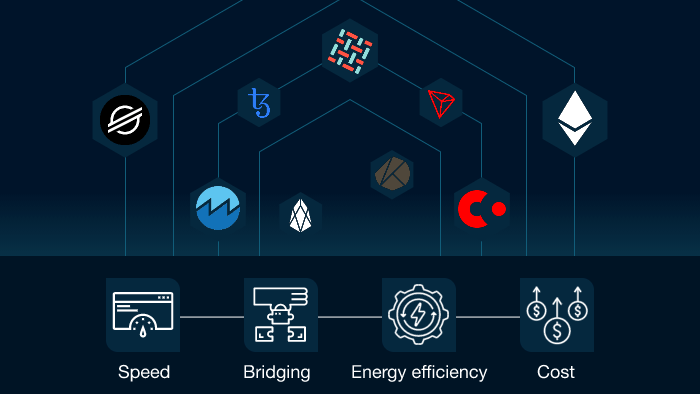
Source: https://scortik.com/choose-blockchain-protocol-suitable-to-your-project/ This article will explain the criteria for selecting a blockchain protocol and how Scortik can assist you in selecting the best protocol for your development needs.
There are various types of blockchain protocols.
Blockchain protocols are the rules and standards that govern how a blockchain network operates. They specify how the network works, such as how data is recorded, validated, and stored on the blockchain, as well as how network participants can access and interact with the blockchain. Different blockchain protocols with varying features and capabilities have been developed to support various use cases. Bitcoin, Ethereum, Hyperledger Fabric, and Corda are examples of blockchain protocols.
Blockchain protocols are classified into three types:
- Public protocols
- Private protocols
- Hybrid protocols
Public Blockchain Protocols
These are permissible, open-source blockchains that anyone can access and use. This means that anyone can download and run a node in order to connect to the network. Ethereum is a publicly accessible protocol that enables users to create and manage smart contracts. On Ethereum, anyone can create a decentralised application (dApp) by purchasing Ether to power their software programmes. Other public blockchain protocols with highly distributed and immutable benefits include Stellar and Bitcoin. The data cannot be changed once it has been verified. It promotes trust and transparency among its participants, but at the expense of efficiency and cost due to its lengthy and energy-intensive verification process.
Private Blockchain Protocols
Private blockchain protocols, as opposed to public protocols, require authorization to access. They also give the appearance of being a centralised organisation. Allowing participants to nominate future members or requiring a user to complete a set of predetermined tasks before being granted admission are two options for granting network access. An entity can join the network to assist with the blockchain’s decentralised maintenance and upkeep. Internal players validate transactions in the system. There are no game-theoretic incentive structures in place to safeguard the network. While private blockchains are more efficient in terms of scaling and legal compliance, they are more vulnerable to network manipulation.
Hybrid Blockchain Protocols
They incorporate both public and private protocols. IT professionals can create a hybrid project by combining private and public chains. Although some information can be stored on private chains, consensus on a different set can be reached on a public chain. It is also referred to as a hybrid protocol.
Check this article about Choosing a Blockchain Protocol Suitable to Your Project to read more.
-
Cosmos Blockchain and dApps
The rise of blockchain technology since the advent in Bitcoin has been an exponential growth. Many people saw a decentralized, distributed ledger a necessity of the day and immediately began developing existing networks or inventing new blockchains. From massive open-source chains to enterprise networks that are solely for business, blockchain protocols designed for a variety of reasons dominate the web3 community in the present. But, one of the drawbacks for the vast majority of these networks is the inability of connecting to one another in order to communicate and exchange data and value. The majority of existing blockchains are isolated and dispersed networks with no connection to each other. A fully functional interoperable protocol was a must within the blockchain ecosystem to link these siloed networks. Cosmos is an internet that connects blockchains was created for the purpose of connecting blockchains.
Cosmos is a blockchain platform designed for creating and connecting multiple independent blockchains to form a vast interoperable network. Cosmos provides a full range of tools to accomplish a variety of tasks, such as hosting an dApp within Cosmos Hub, hosting a dApp in the Cosmos Hub community, developing corporate blockchains, or setting up an individual mode of use.Prior to when Cosmos came along the blockchains were isolated and were not able to communicate with one another. Cosmos is able to overcome these limitations with a new approach. Let’s find out the way Cosmos can be integrated into the wider blockchain ecosystem, and then build an application using the Cosmos SDK.
What is the best way to make Cosmos work within with the Blockchain ecosystem?
To comprehend the way Cosmos is positioned within the ecosystem of blockchain it is first necessary to be aware of the limitations other platforms like Ethereum were unable to overcome. Below are a few issues which led to the development of Cosmos. Cosmos Blockchain platform
Scalability
dApps that are built on top of Ethereum are executed at an average fifteen transactions per second. This is due to the fact that Ethereum makes use of proof-of-work. Ethereum dApps are competing for the specific resources on a single blockchain.
Sovereignty
One of the drawbacks of the application system is that it is limited by sovereignty because they are all part of the identical environment. This creates the two levels of oversight: the application and the underlying environment. If you discover any flaw within the application there is no way to do anything to fix it without the consent of the management of the Ethereum platform. If the application requires an additional feature within the EVM the app must be able to rely on the oversight by the Ethereum platform to allow the feature.
Usability
It’s the limited amount of flexibility available to developers. Because EVM can be described as a sandbox which can be used for all scenarios It maximizes for the common usage scenario. Thus, developers need to compromise on the effectiveness and appearance of the application. They are also limited to a limited number of programming languages and can’t execute code.
The restrictions aren’t specific to Ethereum but apply to all blockchains that form an integrated platform that could meet all needs. This is the point at which Cosmos is a part of the picture.A quick look over the Cosmos Blockchain
Cosmos allows developers to create blockchains that break down the barriers between the blockchains by permitting them to communicate. The purpose to achieve the goal of Cosmos blockchains is to establish an Internet of Blockchains, which allows blockchains to communicate with each and each other in a way that is decentralized.
With Cosmos blockchains, you can complete transactions in a short time, preserve independence and collaborate with other blockchains within the blockchain ecosystem which makes it suitable for a range of applications.
The aim is accomplished through the use of open-source tools, such as Cosmos SDK, IBC and Tendermint that are designed to let developers to build secure, customized and scalable blockchain applications. Let’s take a look at the key tools of the Cosmos ecosystem and learn how to create an app for blockchain using the Cosmos blockchain.
The Cosmos development stack
The Tendermint Core
Tendermint Core Tendermint Core is the software solution that uses the Tendermint Byzantine Fault Tolerance or BFT consensus algorithm. It is a blockchain-based application platform which provides an equivalent to a web server, database and support libraries for blockchain-based applications written with any programming language. It also hosts the inter-blockchain communications protocol or IBC.
The IBC Protocol
IBC is a means by which the network layer along with the consensus layer are able to communicate to the hub as well as all the other blockchains that are connected. Inter-blockchain communication is a safe, reliable and permanent protocol which allows module, that are stable processes that are run by independent machines, to communicate with one another. Any cross-chain-based application, including multichain smart contract apps and cross-chain token transfer or decentralized oracles can be built on top of IBC. It’s an interoperability tool. It also manages data transfer, reliability, and authentication.
Application Blockchain Interface layer
Applications Blockchain Interface layer or ABCI layer allows dApp replication to diverse programming languages. Because this layer isn’t limited to a single language, developers are able to create applications using their blockchain in the language they prefer. In addition, ABCI acts as a bridge between Tendermint Core and Cosmos SDK to ease the interplay with the other.
The Cosmos SDK
Cosmos SDK provides the app layer for the network. It offers a basic blockchain framework to developers interested in developing applications based on Cosmos. It is designed to reduce the complexity by offering the most commonly used features of various blockchains, including the governance, staking, and tokens. It also allows developers to create plugins that can be used to include the additional functions they want to add.
Check Cosmos Review and Rating to read more about their ecosystem.
-
Subscribe
Subscribed
Have a WordPress.com account? Log in now.

